Samsung R95H review: Two-minute review
The R95H leads Samsung's Micro RGB range, the company's debut in the RGB TV market. It delivers particularly impressive movie and gaming performance. Although I wouldn't put it ahead of every rival, it offers a convincing example of the progress RGB televisions are making.
The R95H delivers great overall picture quality, with vibrant colors which also look accurate in most scenes, as well as strong contrast and refined detail. While its black levels don’t quite match those of , they’re still very rich for a backlit TV. It’s not all smooth sailing, as the R95H can get overly bright, especially in Movie mode, and it’s not immune to blooming in very dark scenes. Still, its overall picture quality is of a high standard.
Sound quality on the R95H is solid for the most part, with good accuracy and detail, as well as commendable bass and solid mid-range tones. Speech is clear in most scenes I watched, and there is some sense of surround. However, the soundstage could be wider, and the volume does need to be pushed sometimes, so I’d recommend one of the for those wanting a more of a home-theater experience.
The R95H is up there with the , offering four fully-specced HDMI 2.1 ports along with a low 11.7ms input lag time for smooth gaming performance. There are tons of cloud gaming options available too, and Samsung's Gaming Hub is still an excellent feature. While its Game picture mode could be more accurate, this is still an excellent gaming TV.
Tizen is a good smart TV platform, giving you access to all the major streaming apps, as well as a plethora of AI tools for picture, sound and general usage. Its menus are generally well laid out and easy to navigate, and, while there are some frustrations, such as autoplaying Samsung TV Plus and large banner ads on the home screen, these don’t detract too much from what is a solid smart TV interface.
The R95H is a premium TV, with the 65-inch model priced at $2,799 / £2,899 / AU$4,999. This puts it at a similar price level to flagship OLED TVs, and while I don’t think it quite tops OLED, it shows how rapidly RGB tech is advancing.
A quick note on the images in this review: the TV may appear to have a red tint, but this is caused by the camera reacting to the anti-glare screen, and it not something that's discernible when viewing content on the TV.
Samsung R95H review: Prices & release date
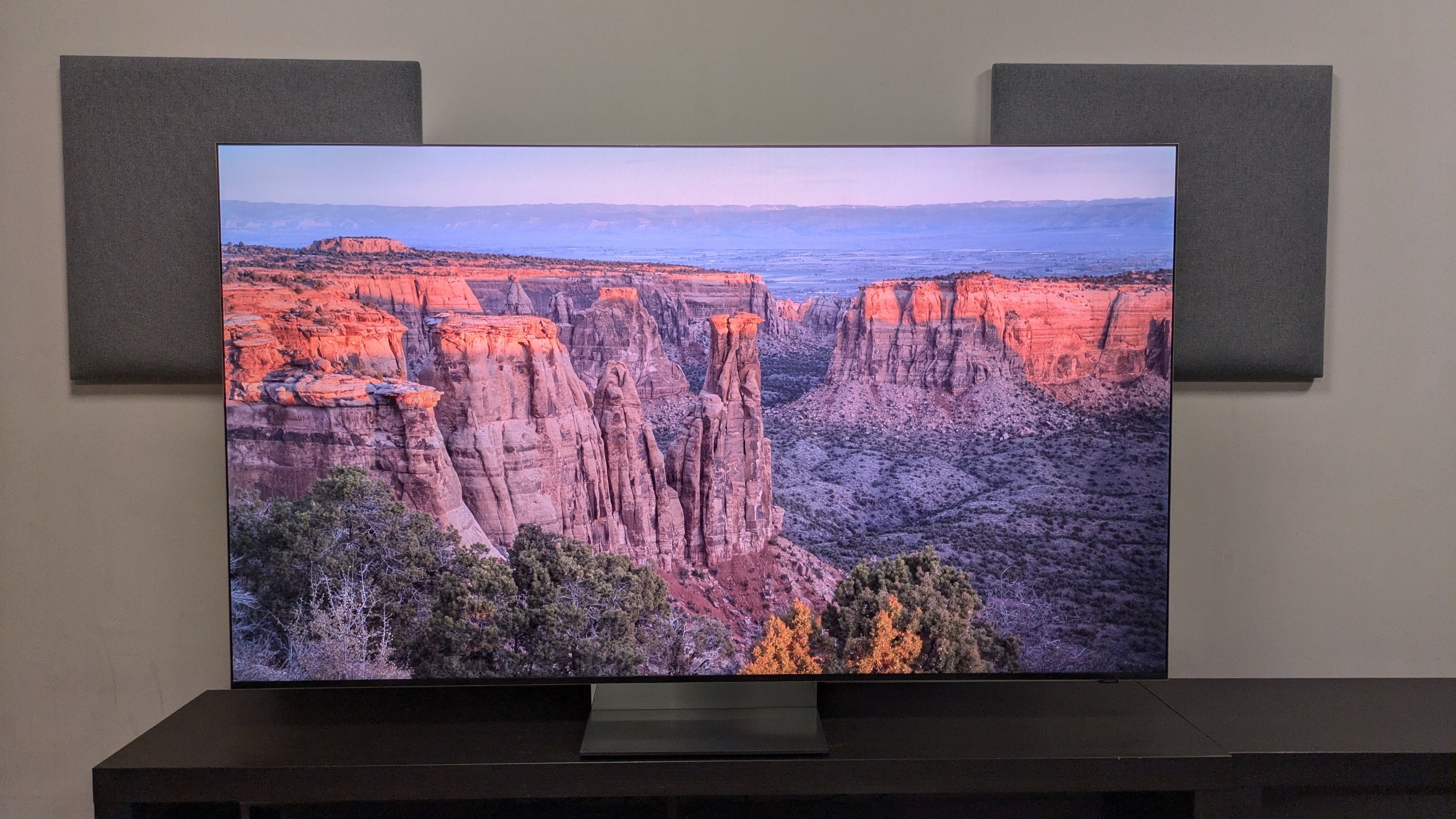
The R95H delivers good brightness and detail that gives pictures a 3D-like effect (Image credit: Future)
Release date: July 2026
65-inch: $3,199 / £3,099 / AU$5,299
75-inch: $4,499 / £3,999 / AU$7,999
85-inch: $5,499 / £5,899 / AU$9,999
The Samsung R95H is the flagship model in Samsung’s Micro RGB TV lineup, sitting above the Samsung R85H. It’s available in 65, 75 and 85-inch sizes. The launch price for the 65-inch model I tested is $3,199 / £3,099 / AU$5,299, putting it at the premium end of the market.
Since its launch in July 2026, prices have dropped across all sizes in both the US and UK. The 65-inch has dropped to $2,799 / £2,899, putting it in similar price brackets to Samsung’s flagship S95H / S99H OLED (priced at $2,899 / £2,899) and ’s flagship G6 OLED ($2,699 / £2,999). In the US and UK the R95H is cheaper than ’s rival RGB, the Bravia 9 II, which is priced at $3,499 / £3,499 / AU$5,995.
Samsung R95H review: Specs
Samsung R95H review: Benchmark results
1 / 4
Brightness measurements
HDR FilmmakerHDR StandardSDR FilmmakerSDR Standard
Samsung R95H
HDR Filmmaker Mode (10% window)
1977
HDR Filmmaker Mode (Fullscreen)
612
Samsung S95H/S99H
HDR Filmmaker Mode (10% window)
2739
HDR Filmmaker Mode (Fullscreen)
449
Sony Bravia 7 II
HDR Filmmaker Mode (10% window)
1114
HDR Filmmaker Mode (Fullscreen)
829
07501,5002,2503,000
nits
HDR Filmmaker Data
Product | HDR Filmmaker Mode (10% window) (nits) | HDR Filmmaker Mode (Fullscreen) (nits) |
Samsung R95H | 1977 | 612 |
Samsung S95H/S99H | 2739 | 449 |
Sony Bravia 7 II | 1114 | 829 |
Samsung R95H
HDR Standard Mode (10% window)
2066
HDR Standard Mode (Fullscreen)
647
Samsung S95H/S99H
HDR Standard Mode (10% window)
2831
HDR Standard Mode (Fullscreen)
463
Sony Bravia 7 II
HDR Standard Mode (10% window)
1295
HDR Standard Mode (Fullscreen)
788
07501,5002,2503,000
nits
HDR Standard Data
Product | HDR Standard Mode (10% window) (nits) | HDR Standard Mode (Fullscreen) (nits) |
Samsung R95H | 2066 | 647 |
Samsung S95H/S99H | 2831 | 463 |
Sony Bravia 7 II | 1295 | 788 |
Samsung R95H
SDR Filmmaker Mode (10% window)
115
SDR Filmmaker Mode (Fullscreen)
185
Samsung S95H/S99H
SDR Filmmaker Mode (10% window)
220
SDR Filmmaker Mode (Fullscreen)
219
Sony Bravia 7 II
SDR Filmmaker Mode (10% window)
90
SDR Filmmaker Mode (Fullscreen)
94
075150225300
nits
SDR Filmmaker Data
Product | SDR Filmmaker Mode (10% window) (nits) | SDR Filmmaker Mode (Fullscreen) (nits) |
Samsung R95H | 115 | 185 |
Samsung S95H/S99H | 220 | 219 |
Sony Bravia 7 II | 90 | 94 |
Samsung R95H
SDR Standard Mode (10% window)
413
SDR Standard Mode (Fullscreen)
187
Samsung S95H/S99H
SDR Standard Mode (10% window)
229
SDR Standard Mode (Fullscreen)
229
Sony Bravia 7 II
SDR Standard Mode (10% window)
608
SDR Standard Mode (Fullscreen)
476
0200400600800
nits
SDR Standard Data
Product | SDR Standard Mode (10% window) (nits) | SDR Standard Mode (Fullscreen) (nits) |
Samsung R95H | 413 | 187 |
Samsung S95H/S99H | 229 | 229 |
Sony Bravia 7 II | 608 | 476 |

HDR color gamut
Closer to 100% is better. Taken using a colorimeter and test pattern generator.
Samsung R95H
UHDA-P3
148
BT.2020
94.1
Samsung S95H/S99H
UHDA-P3
99.9
BT.2020
89.2
Sony Bravia 7 II
UHDA-P3
98.6
BT.2020
89.6
037.575112.5150
HDR Filmmaker Data
Product | UHDA-P3 () | BT.2020 () |
Samsung R95H | 148 | 94.1 |
Samsung S95H/S99H | 99.9 | 89.2 |
Sony Bravia 7 II | 98.6 | 89.6 |
Picture accuracy
A lower score is better. Taken using a colorimeter and test pattern generator.
SDR Delta-E
Samsung R95H
3.7
Samsung S95H/S99H
1.6
Sony Bravia 7 II
6.5
01234567
SDR Delta-E Data
Product | Value |
Samsung R95H | 3.7 |
Samsung S95H/S99H | 1.6 |
Sony Bravia 7 II | 6.5 |
Input lag
Lower is better. Taken using a Leo Bodnar 4K HDMI Video Signal Lag Tester.
Samsung R95H
4K 60Hz
11.7
1080p 120Hz
9.4
Samsung S95H/S99H
4K 60Hz
9.5
1080p 120Hz
5
Sony Bravia 7 II
4K 60Hz
10.4
1080p 120Hz
5.7
03.757.511.2515
ms
HDR Filmmaker Data
Product | 4K 60Hz (ms) | 1080p 120Hz (ms) |
Samsung R95H | 11.7 | 9.4 |
Samsung S95H/S99H | 9.5 | 5 |
Sony Bravia 7 II | 10.4 | 5.7 |
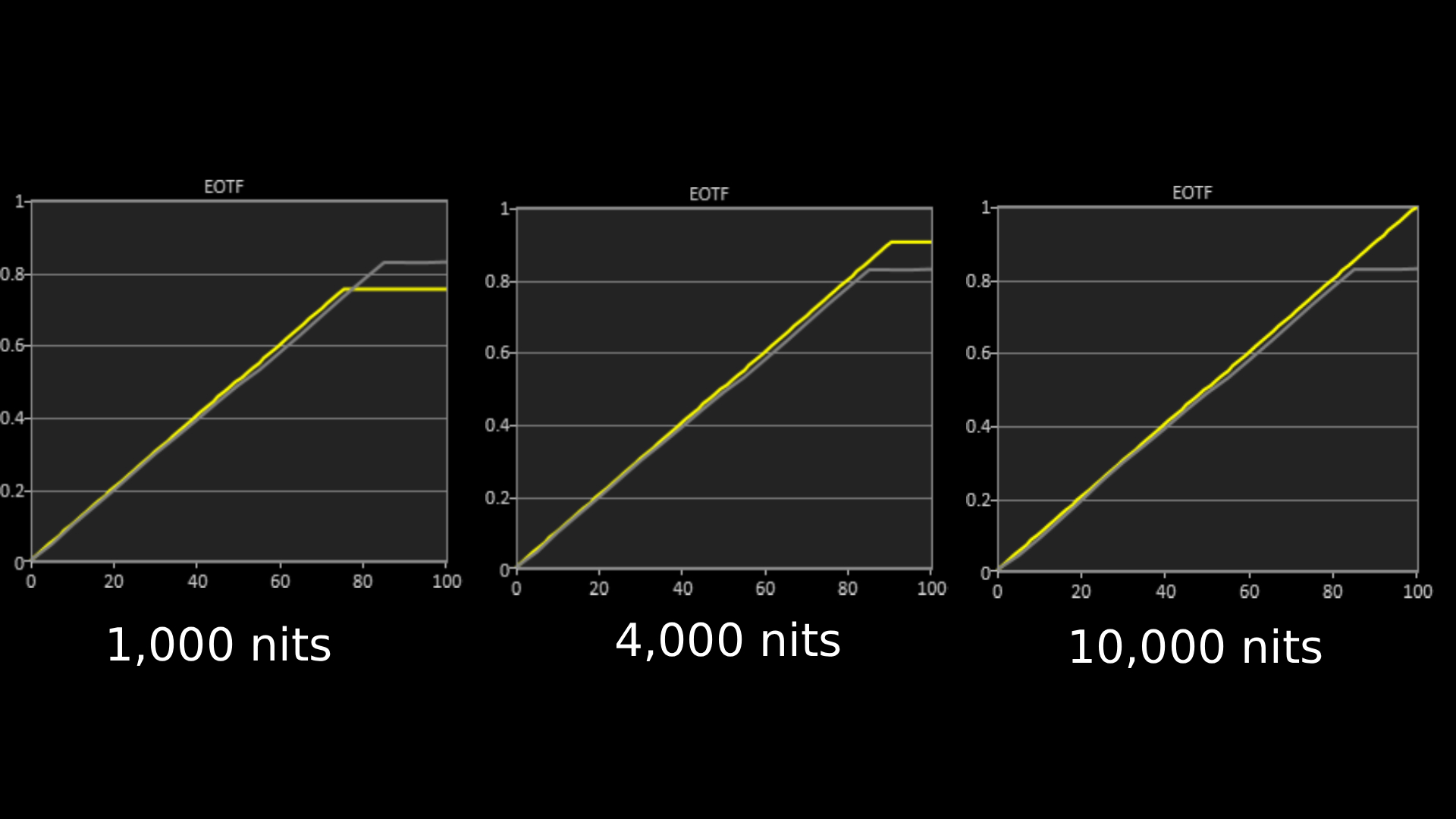
The above EOTF graphs show the accuracy of the Samsung R95H for hitting different HDR brightness levels in grayscale. The closer to the yellow line, the more accurate a TV is. As with all our tests, these results are out of the box, without calibration, to demonstrate the performance most people will see. As you can see, the R95H did very well on all three target tests. (Image credit: Future)
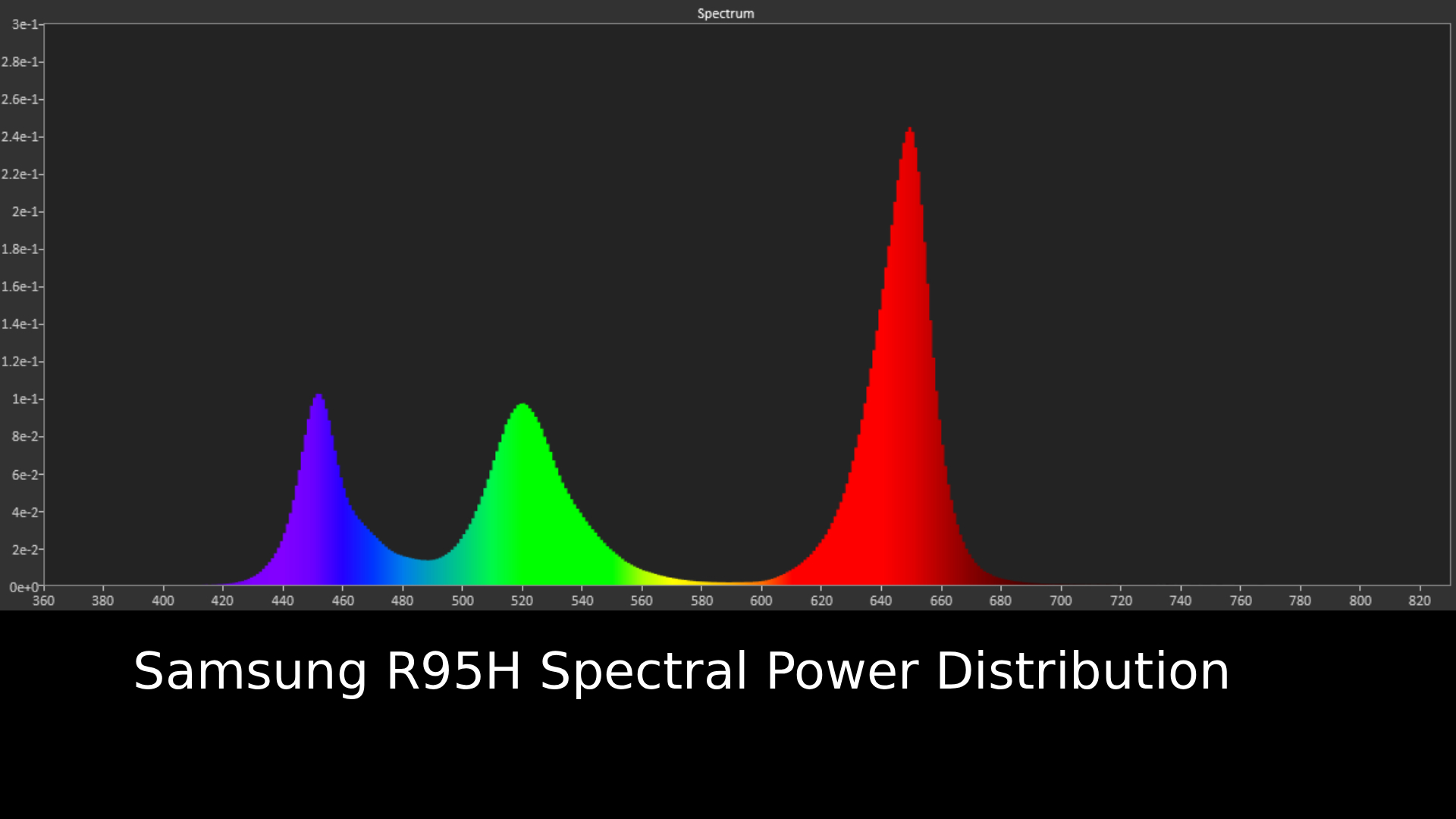
Spectral power distribution refers to the intensity of light that a source will display at various wavelengths of color. It can reveal how accurate a source can show color at different light levels, and can be instructive to understand how a TV is handling color. (Image credit: Future)
Samsung R95H review: Features
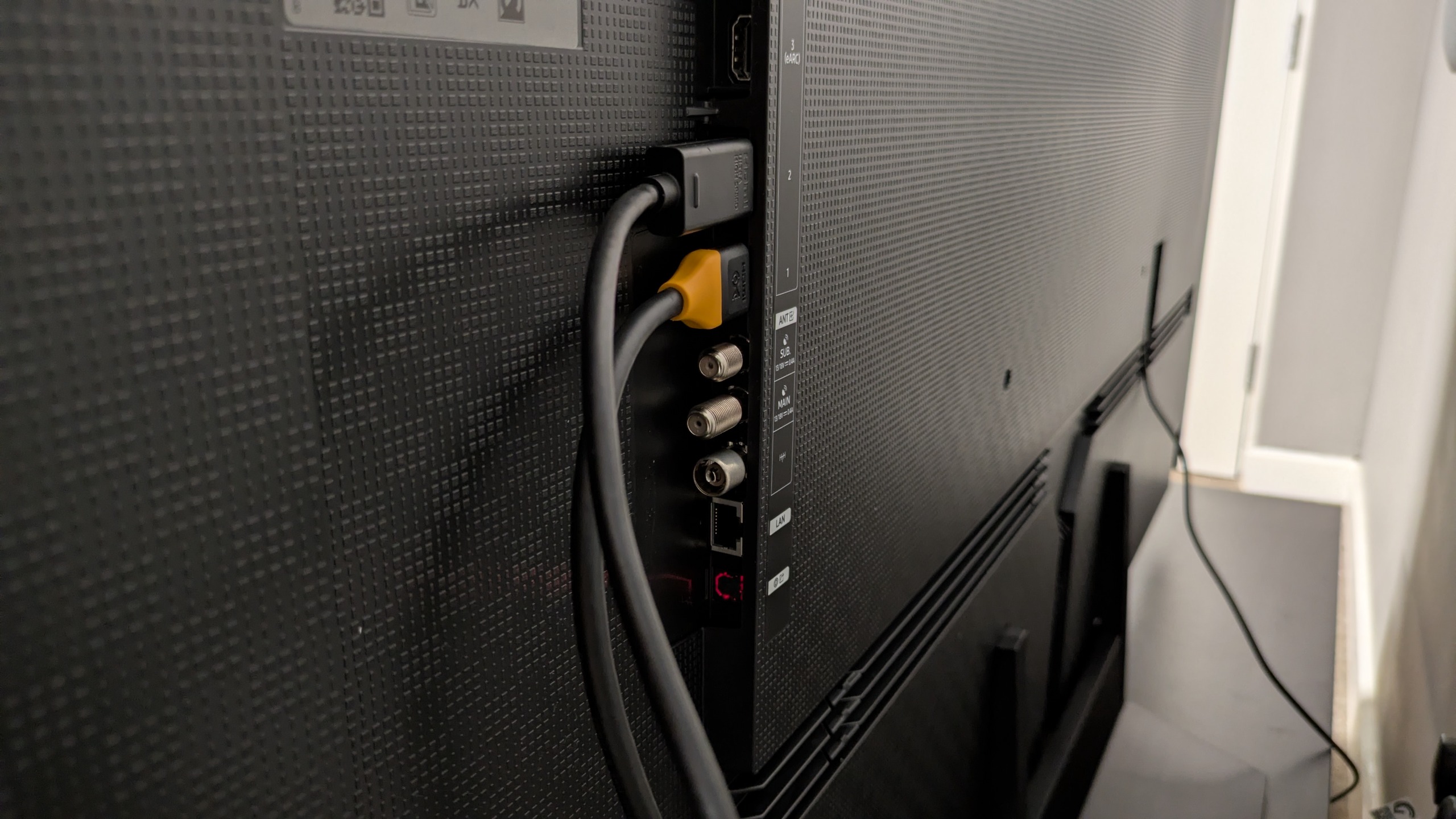
The R95H is equipped with four HDMI 2.1 ports (Image credit: Future)
RGB backlight
Glare-free screen
Samsung Vision AI and Tizen smart TV platform
The R95H uses Samsung’s ‘Micro RGB’ backlight technology, which uses LEDs that are smaller than mini-LEDs, and which consist of red, green and blue LEDs (hence RGB) rather than the traditional white in order to deliver bolder colors and brightness.
It comes equipped with the Samsung Micro RGB AI Engine Pro processor, which has features such as Micro RGB Precision Color, AI Upscaling Pro and Color Booster Pro. The TV itself also has a Glare Free screen, an anti-reflection matte screen that has featured in several of Samsung's TVs, including the Samsung S95H / S99H.
In terms of support, the R95H supports HDR10+, but as usual, there is no support for Dolby Vision.
For gaming, the R95H has four HDMI 2.1 ports, which support 4K 165Hz, full VRR including Freesync and G-Sync, ALLM and HDR10+ gaming. It also supports cloud gaming apps from the likes of Xbox and GeForce Now. The R95H is also compatible with the Wireless One Connect Box, which can be used in tandem with the TV’s built-in ports, meaning there are a potential eight HDMI 2.1 ports on offer.
The R95H has a 4.2.2 channel speaker array, totaling 70W of power. Supported sound features include Object Tracking Sound+ (OTS+), Active Voice Amplifier Pro, Adaptive Sound Pro and AI Sound Controller Pro. The R95H supports Dolby Atmos, but not DTS:X.
The R95H’s smart TV platform is Samsung’s own One UI Tizen, which supports major streaming apps including Netflix and Prime Video, and for those in the UK it supports all major apps including BBC iPlayer and ITVX. There's also support for Samsung Vision AI, which enables AI features such as AI Soccer Mode Pro and Generative Wallpaper.
Feature score: 5 / 5
Samsung R95H review: Picture quality
Image 1 of 2
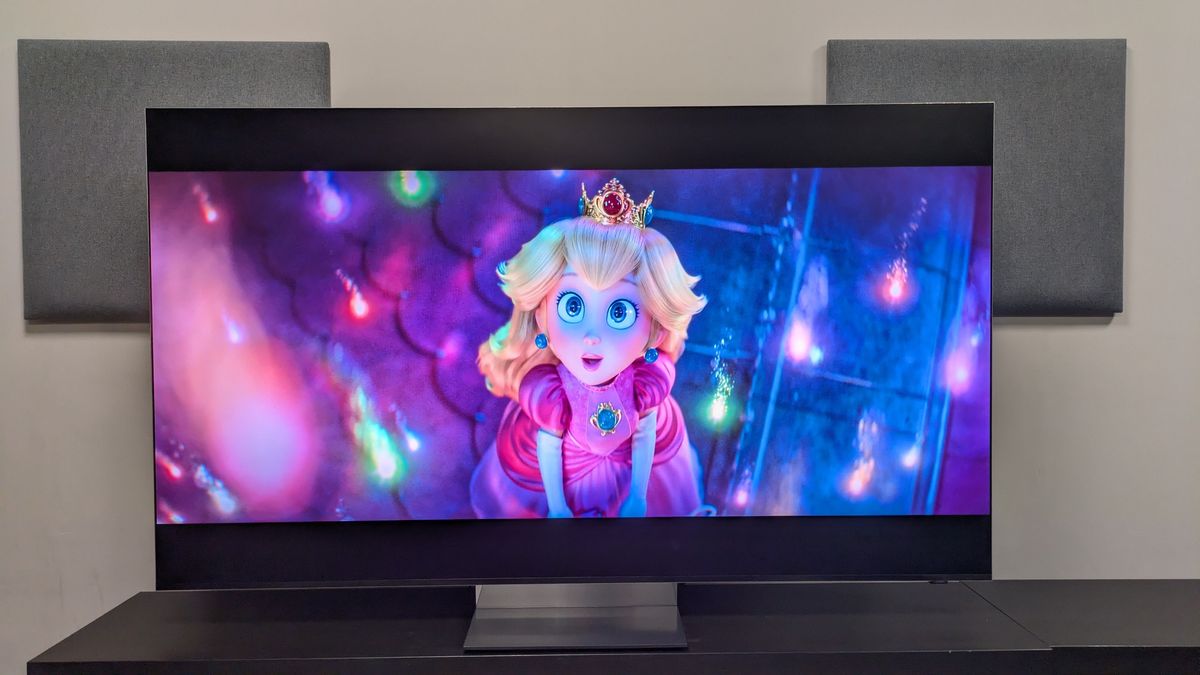
The R95H's color reproduction is excellent, shown in the bright highlights in moves like The Super Mario Galaxy Movie (pictured) (Image credit: Nintendo / Universal Pictures / Future)
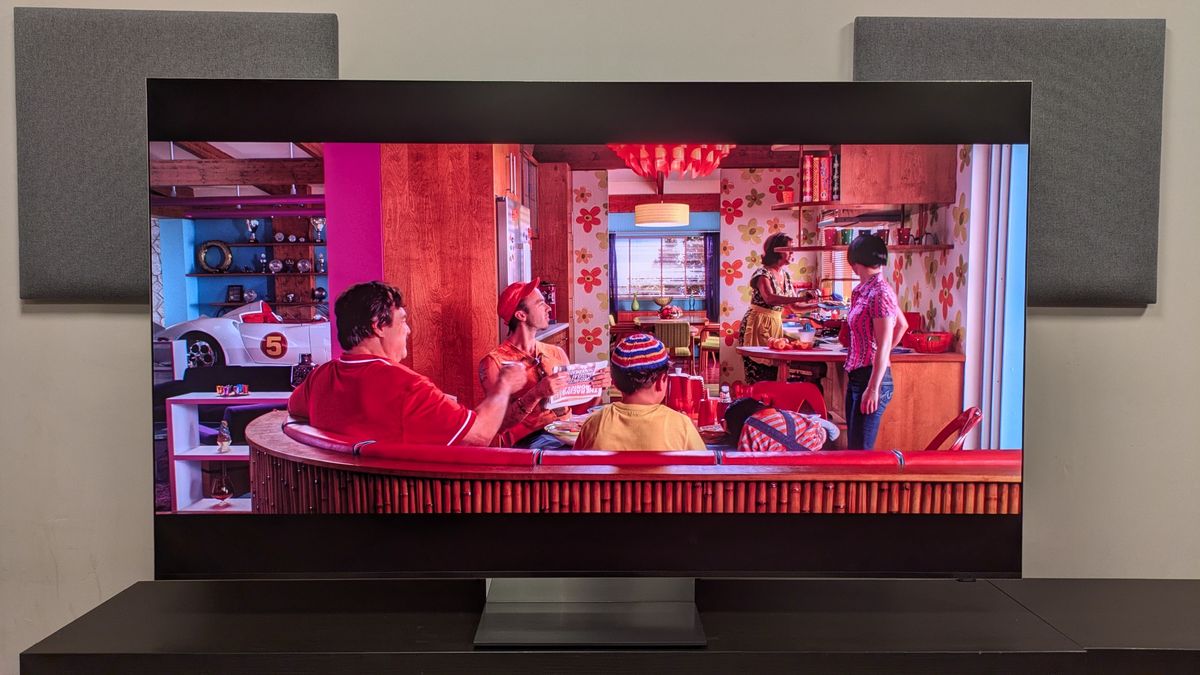
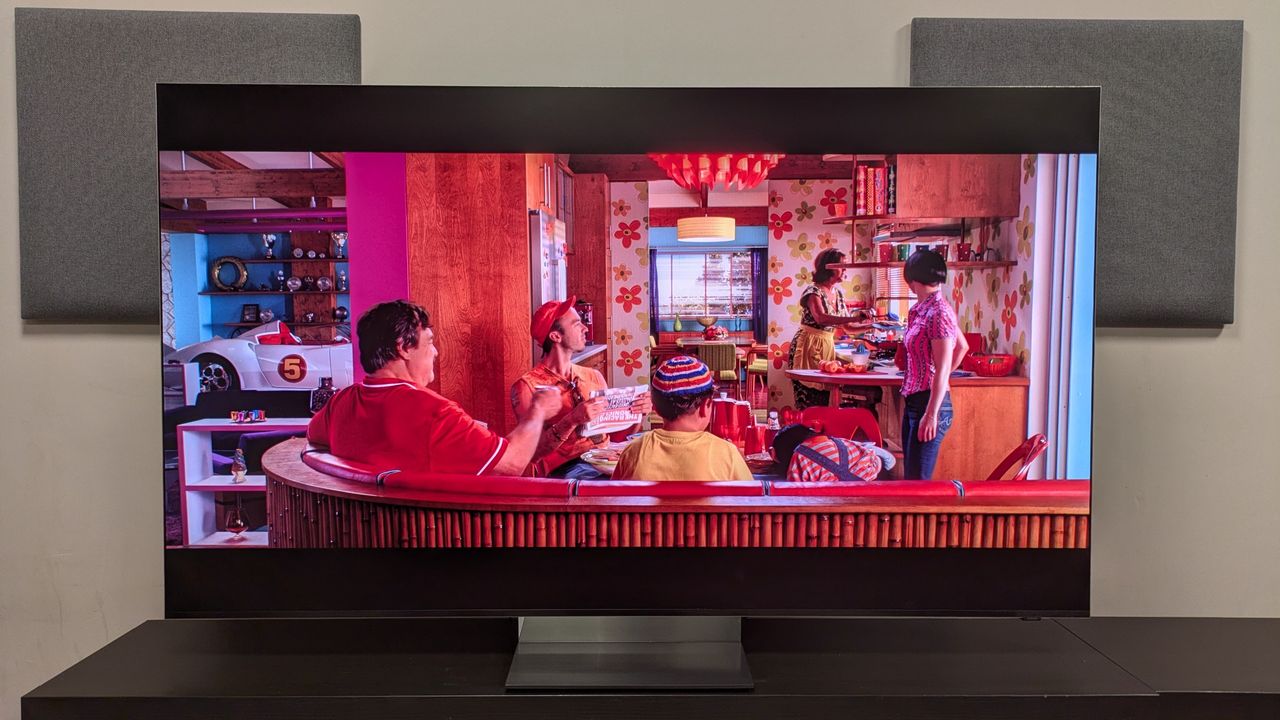
It's not just animation where the R95H shines, but also with the color pop in real-world movies like Speed Racer (Image credit: Warner Bros / Future)
Image 1 of 2
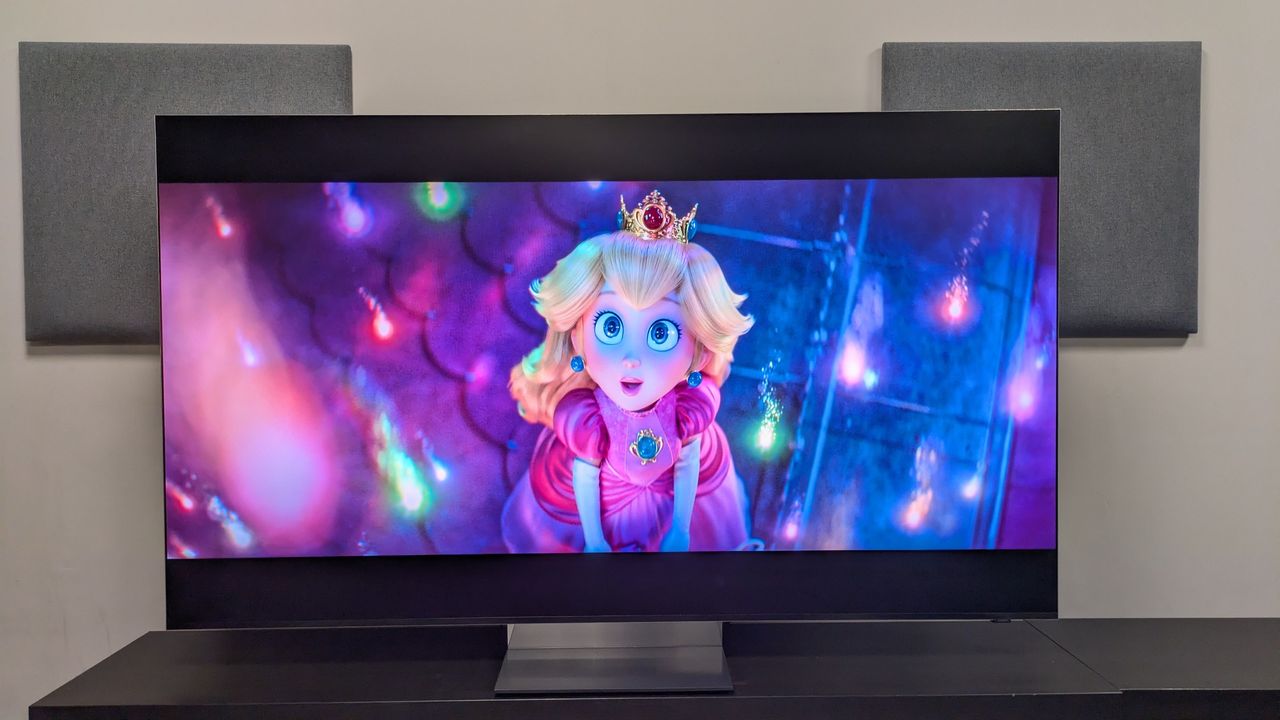
Image 2 of 2
Strong contrast and detail
Bold colors
Effective anti-glare
Starting with some brightness measurements, the R95H registered 1,977 nits and 2,066 nits peak HDR brightness in Filmmaker mode and Standard mode respectively. These are solid brightness results, but surprisingly lower than those of Samsung’s flagship OLED, the S95H/S99H, which registered 2,739 nits and 2,831 nits in the same modes respectively.
Where the R95H has an advantage over OLED is in its fullscreen HDR brightness, which hit 612 nits and 600 nits in the same Filmmaker and Standard picture modes, roughly 150 nits higher than the S95H/S99H OLED. While these numbers are solid, they're lower than those of rival RGB TVs such as the UR8, which hit over 750 nits in both picture modes, and even the Sony Bravia 7 II, which hit over 800 nits in its own Filmmaker mode.
The R95H showcases good upscaling when watching lower-resolution and SDR content. Watching various channels on Samsung TV Plus, from America’s Got Talent re-runs to news channels, the picture looked more detailed than anticipated, showing the R95H’s effective upscaling.
Moving on to the reference 4K Blu-rays I use for testing, the R95H demonstrated very good picture quality. RGB’s selling point is its color reproduction, and the R95H succeeded here. Throughout The Super Galaxy Movie, colors were bold and vibrant, shown in particular whenever the Lumas were on screen. Colors also appeared accurate throughout, with the red of ’s overalls looking true to life. I did notice that while watching in Movie mode, there was some clipping of bright objects, and color luminance could look a little distorted at times. Dropping the brightness down to 40 improved this.
In the live-action movie, Speed Racer, I was impressed at how the R95H rendered the gaudy, saturated color scheme of the Racer household, with its vibrant greens and oranges. It captured the oversaturated look, while still delivering realistic colors. While I did prefer the Sony Bravia 7 II’s colors in my , in isolated viewing, the R95H’s colors were impressive. The R95H did, however, reproduce accurate and realistic skin tones throughout my viewing.
Measuring the R95H’s color gamut coverage, it registered a staggering 148% of the DCI-P3 color gamut, as well as a 94.1% of the BT.2020 color space. These are incredible results, rivaling the best projectors, and the BT.2020 result rivals QD-OLED, found in Samsung's flagship S95H/S99H TVs.
Image 1 of 2
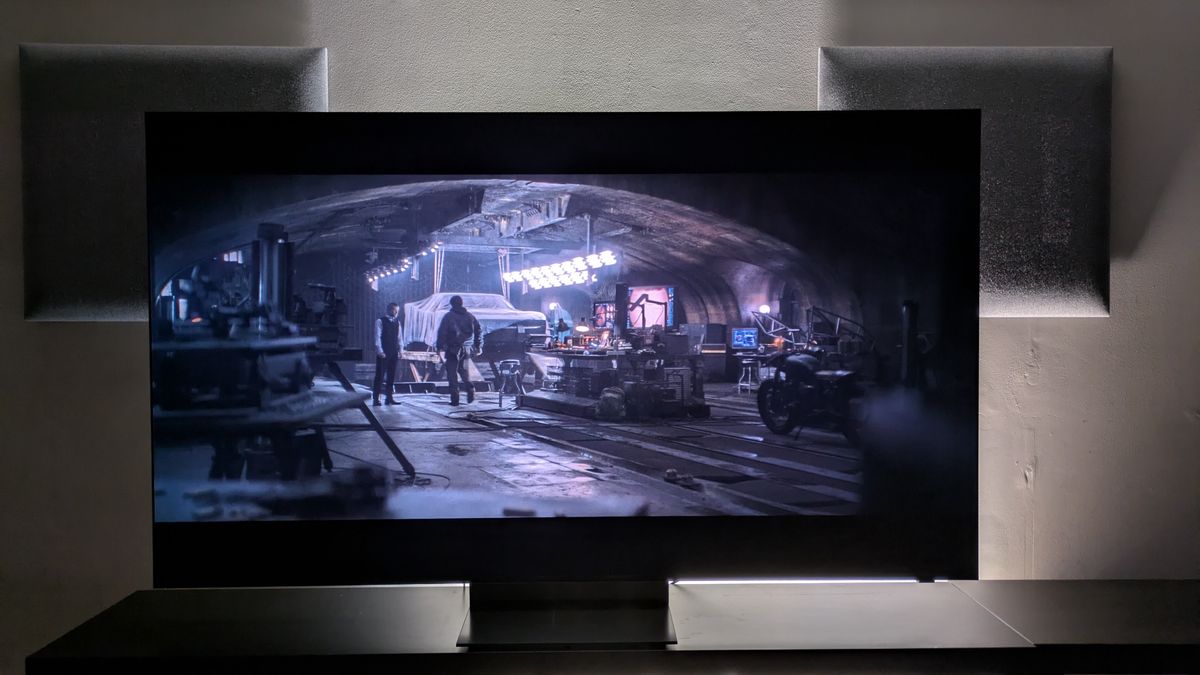
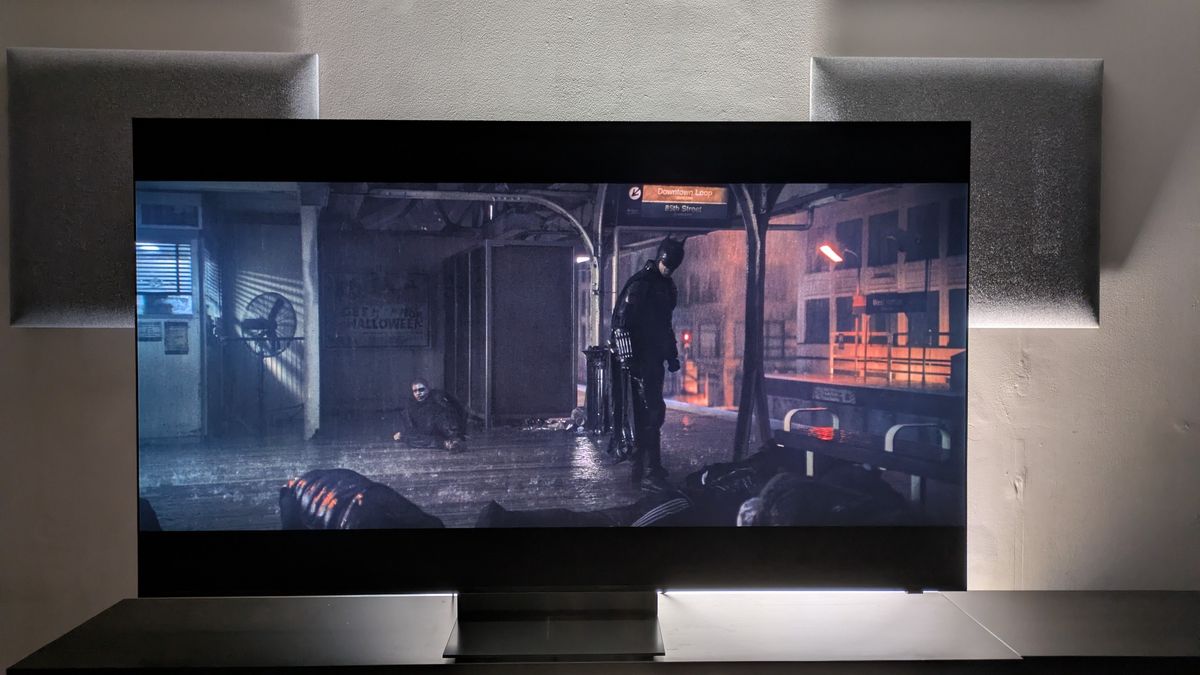
The Batman is a great showcase for the R95H's strong contrast (Image credit: Warner Bros / Future)
(Image credit: Warner Bros / Future)
Image 1 of 2
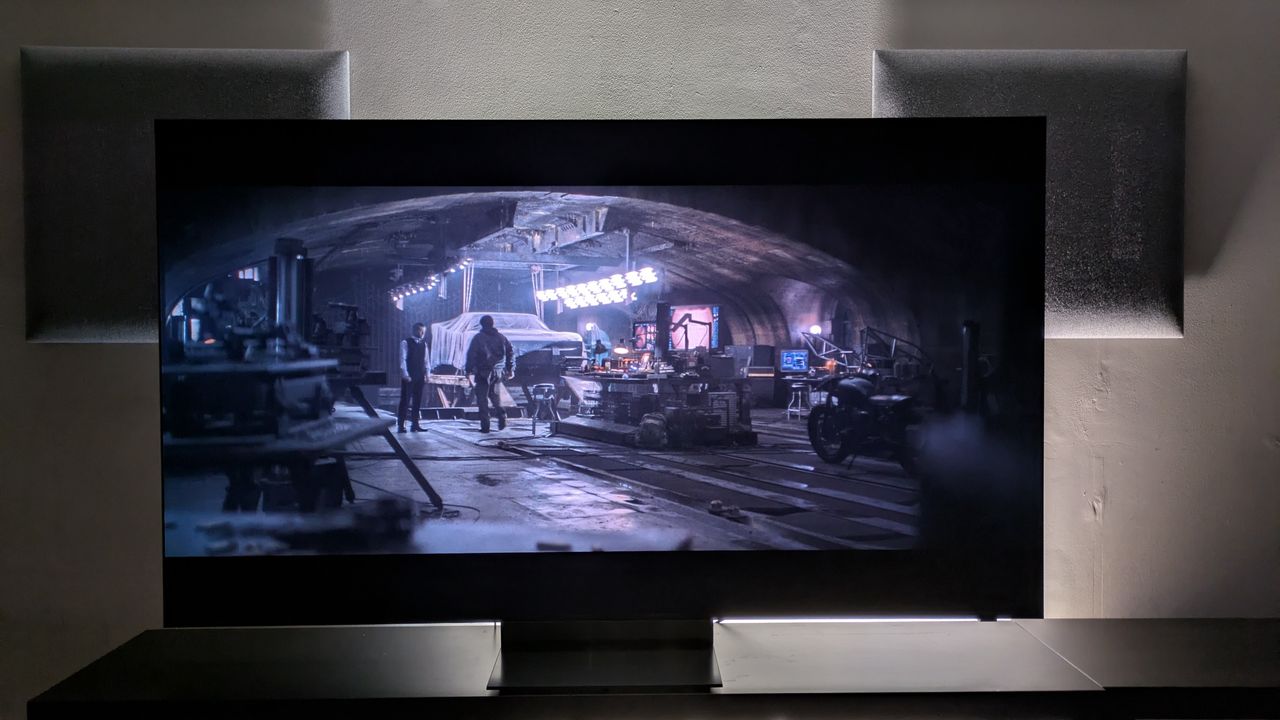
Image 2 of 2
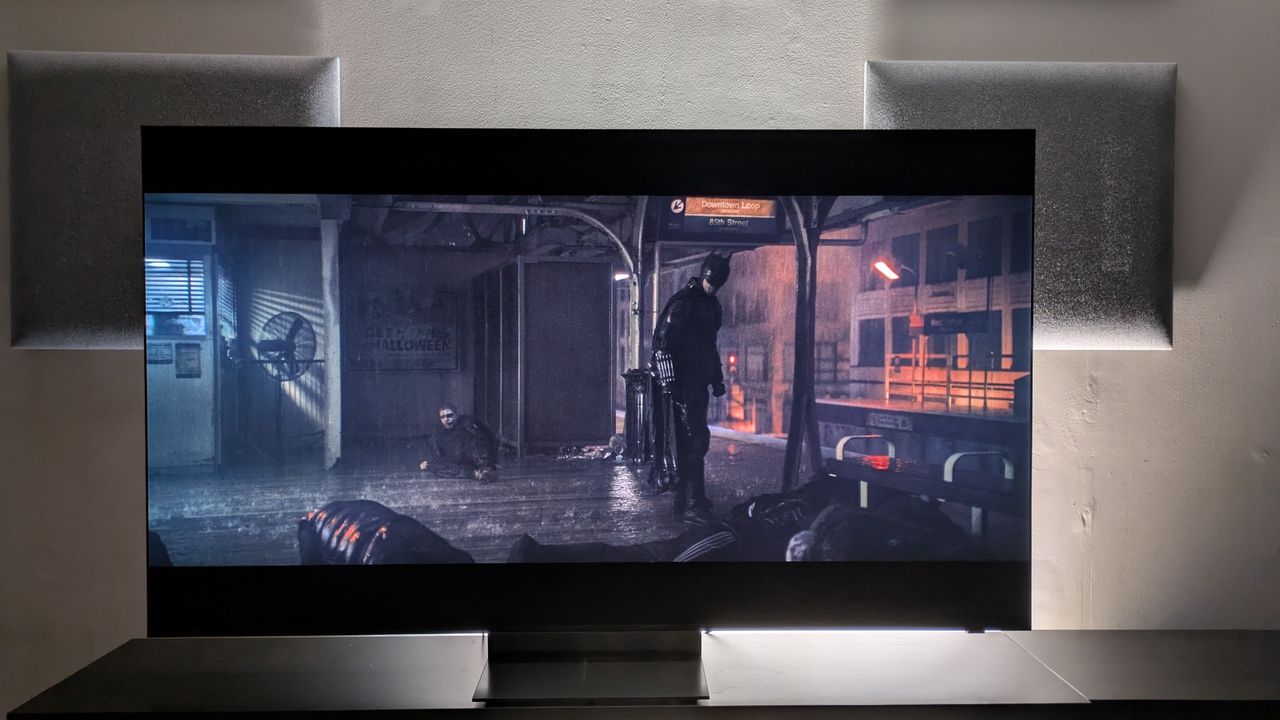
Switching to The Batman for higher-contrast and darker scenes, the R95H demonstrated strong contrast in almost every scene, with a great balance between light and dark tones. This was most evident in the crime scene at Mayor Mitchell’s house, and in the Batcave. The R95H also delivered excellent shadow detail, with objects like paintings on the wall of Mitchell’s house still legible even in the most shadowed areas.
I did find that while I could watch The Batman in bright conditions, thanks to the R95H’s effective glare-free screen, it was best watched in Filmmaker mode in more ambient/dimmer conditions. In Movie mode, The Batman had a tendency to look over-sharp and over-bright in places.
While its black tones weren’t quite OLED-level, the R95H did deliver some seriously rich, deep blacks in Alien: Romulus. Shots of space looked as inky as I could have hoped for, and were impressive for a backlit TV.
The R95H also demonstrated strong viewing angles, and while there was some blooming present in some scenes in The Batman and Alien; Romulus when I viewed the TV off-center, its backlight control was far more effective than you’ll see from standard LED and mini-LED TVs.
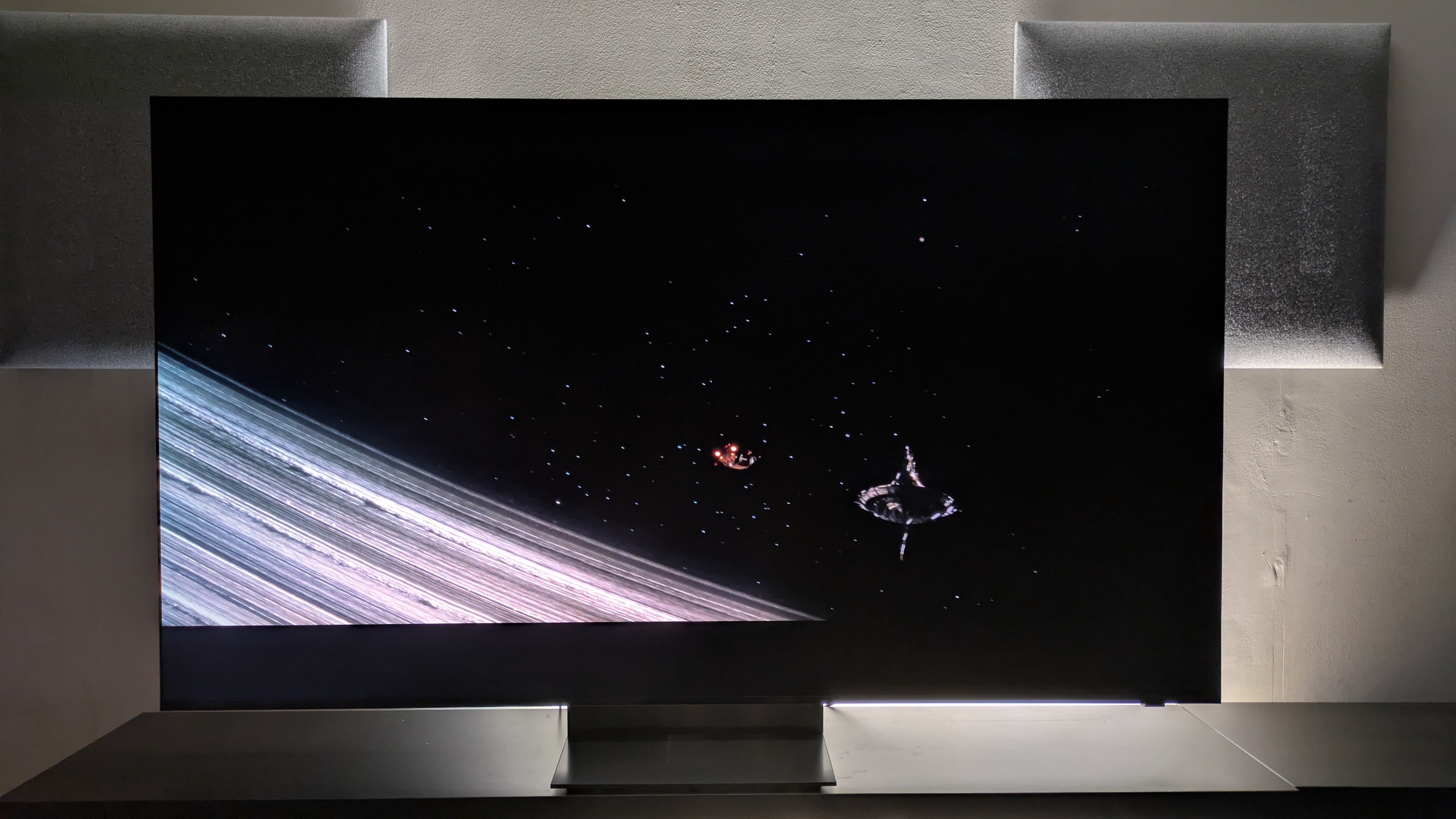
While the R95H's black levels don't beat OLED, they are very strong for a backlit TV (Image credit: 20th Century Studios / Future)
Finally, for motion, the R95H is capable of handling fast-paced scenes from movies like Speed Racer, as cars weave around the track. It showed some judder as commentators panned across the screen, but I’ve found every TV has struggled with this. For the best motion, I found setting blur and judder reduction to 3 looked smooth without venturing into soap opera-effect territory.
For sports, I watched some Major League Soccer highlights via Apple TV, and the R95H not only handled the action well but produced a very natural picture in Standard mode (my preferred picture mode for sports) that I found pleasing to watch.
Picture quality score: 4.5 / 5
Samsung R95H review: Sound quality
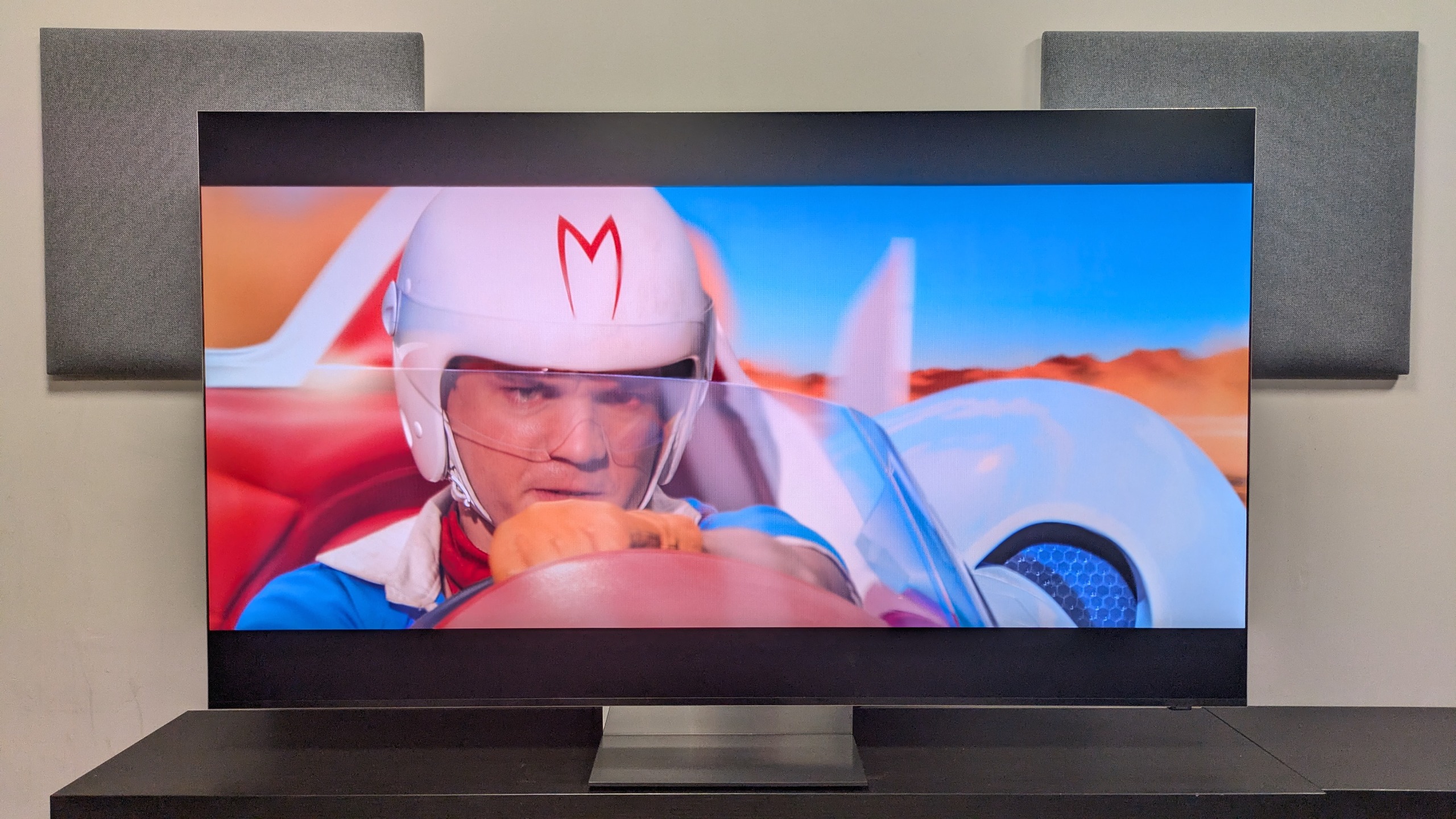
The R95H's speakers are accurate, perfect for movies like Speed Racer, but its bass levels and soundstage could be better (Image credit: Warner Bros / Future)
Effective OTS+ results in great sound positioning
Decent bass and mid range
Sound can feel contained to rear of the screen
The R95H’s built-in speaker array is a 4.2.2 channel, 70W system. It supports Dolby Atmos and has two preset sound modes: Standard and Amplify. There are AI sound features such as Adaptive Sound Pro available to use.
Watching the Batmobile chase scene from The Batman and the various race scenes in Speed Racer, with the TV set to its Amplify sound mode, I was unsurprised to hear that the R95H delivered accurate sound that was well mapped with the action on the screen, something I’ve found with a lot of Samsung TVs, thanks to its OTS+ feature. Whether it was a spray of bullets hitting the Batmobile in The Batman or the sound of the Mach 5 grinding a rail in Speed Racer, the sound accuracy was impressive.
The speakers deliver good mid-range tones throughout, as well as some punchy bass that accurately captures the rumble of the Batmobile’s engine and the roar of the race cars in Speed Racer. There were some impressive surround effects in both reference movies too.
While the speakers are generally decent, I did have to push the volume to higher levels (70+ out of 100) to get a more cinematic experience. The bass also felt flat at times, and sound did still feel contained to the rear of the screen. Turning on Adaptive Sound in the AI settings added more width, but at the cost of bass. While its sound is decent, those wanting a more cinematic experience would benefit from a soundbar.
Sound quality: 4 / 5
Samsung R95H review: Design
Image 1 of 2
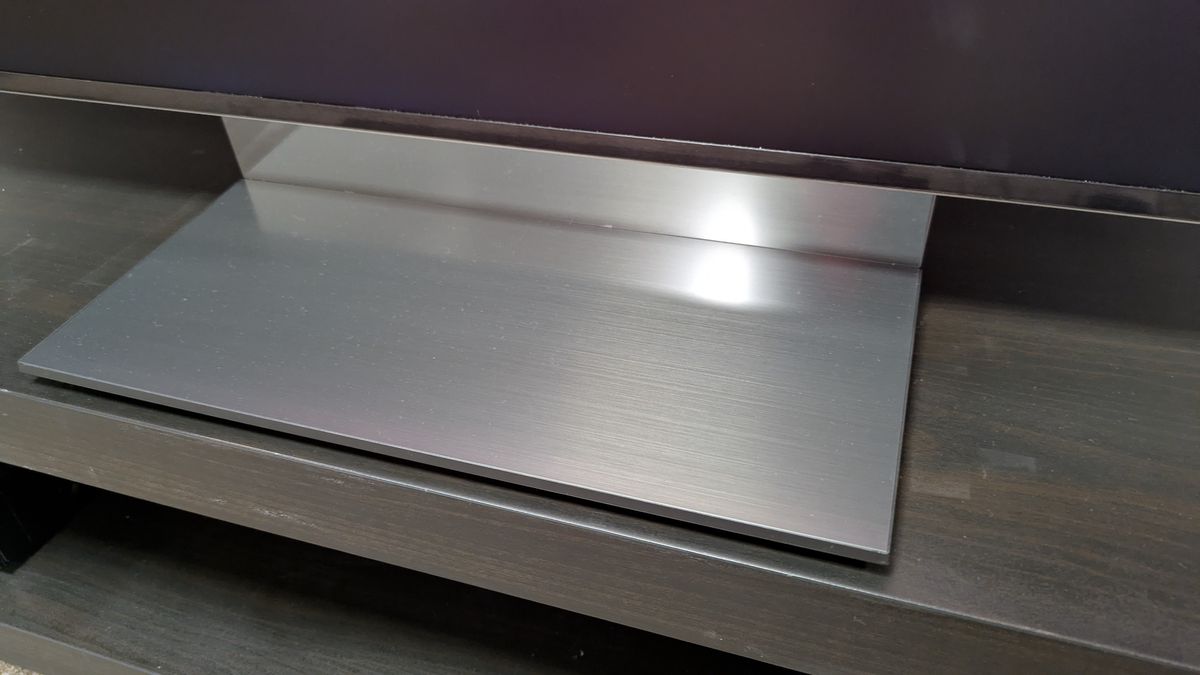
The R95H looks premium with a central pedestal stand (Image credit: Future)
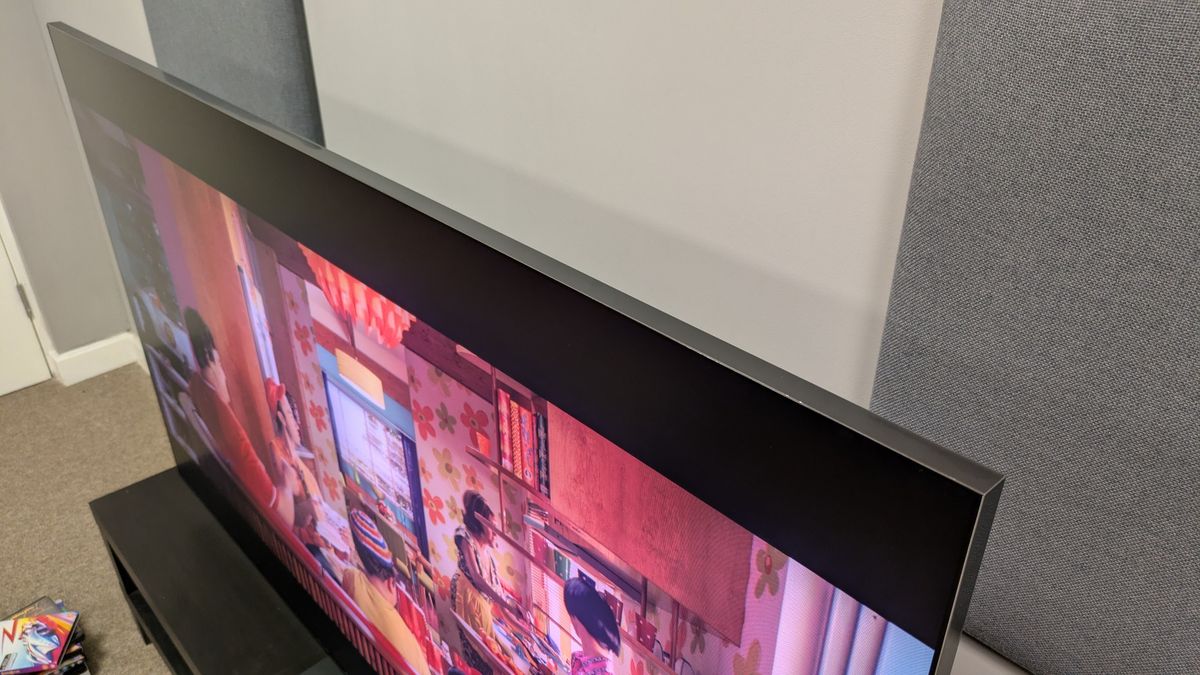
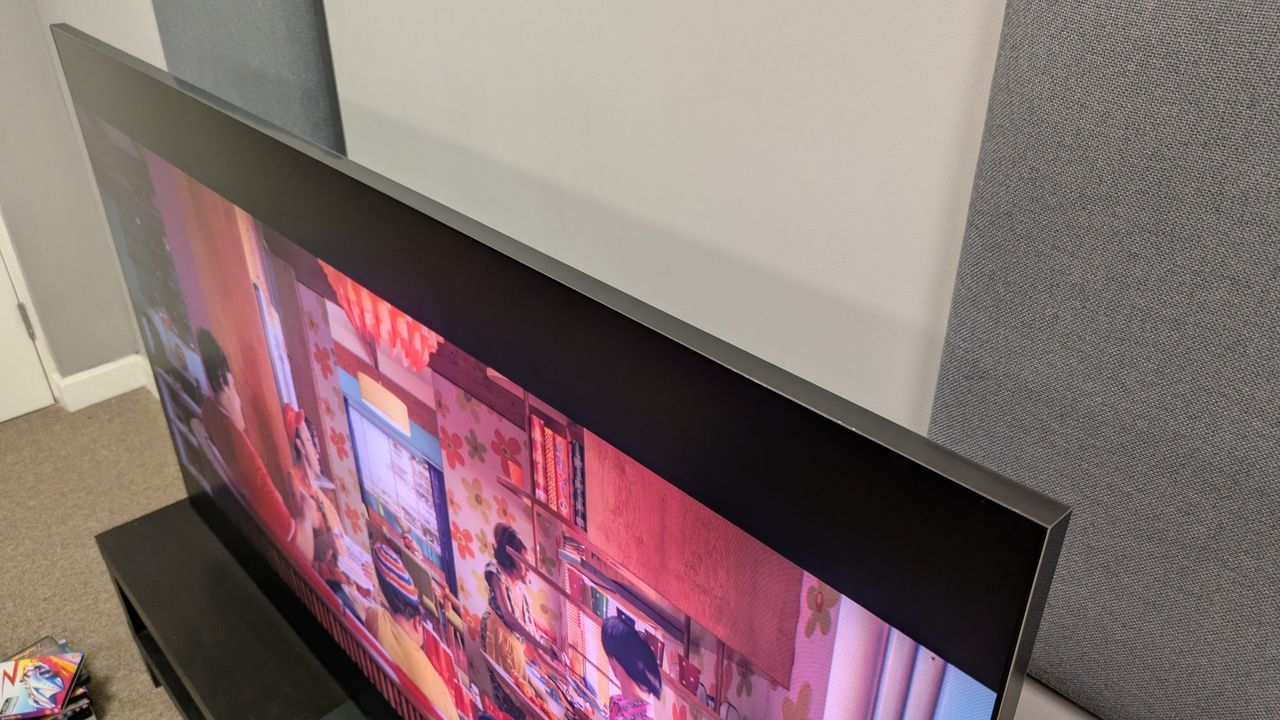
The R95H is trimmer than other RGB TVs I've tested so far (Image credit: Future)
Image 1 of 2
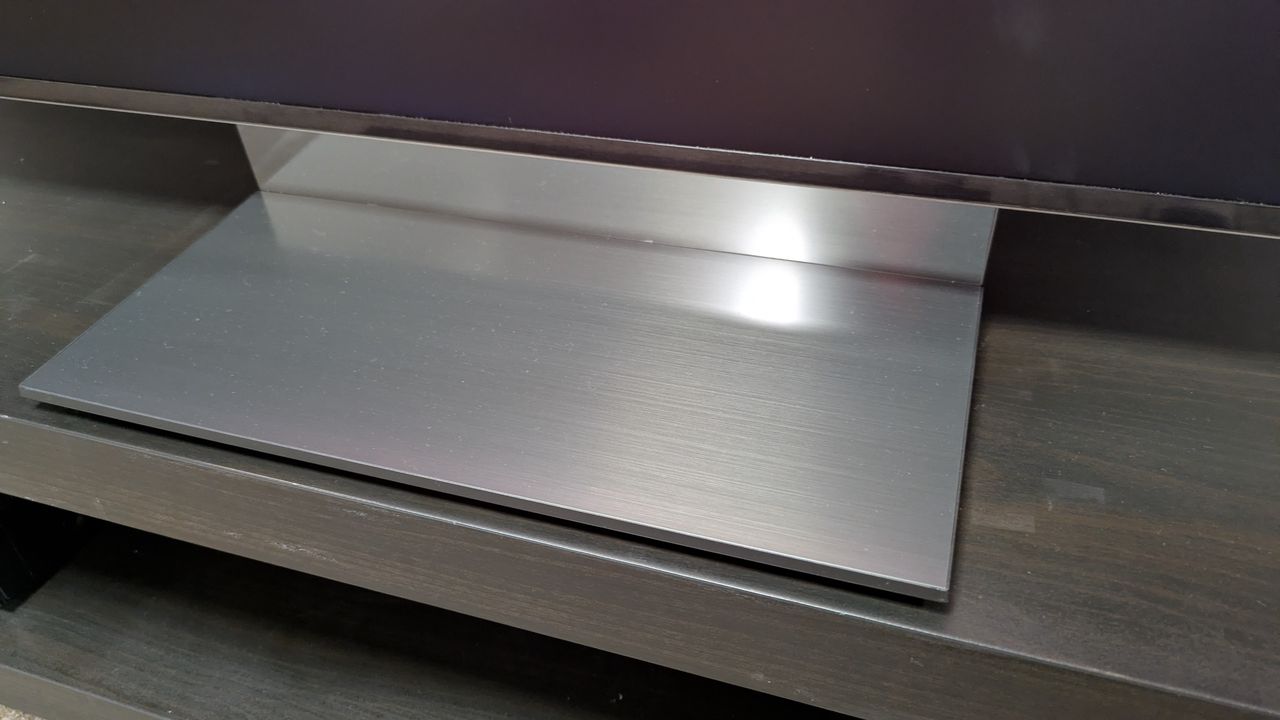
Image 2 of 2
Polished frame
Thinner than other RGB TVs I’ve tested
Light but sturdy
The R95H takes a lot of design cues from other Samsung TVs, with a sleek, silver frame that gives the TV a premium look. Compared to other RGB TVs I’ve tested, the R95H is thinner, which again gives it an appealing look. It has a central pedestal stand that feels sturdy when attached, while the TV itself feels light for a 65-inch, and lighter than other RGB TVs I’ve tested.
The screen has a bezel-less design, giving maximum room to the pictures on screen. The R95H also has the aforementioned glare-free matte screen for easier viewing in bright conditions.
The supplied remote is the Samsung SolarCell remote, which can be recharged via the rear solar panel or via USB-C. The remote has shortcut buttons to major apps such as Netflix, as well as an AI button and mic button for voice control.
Design score: 4.5 / 5
Samsung R95H review: Smart TV & menus
Image 1 of 2
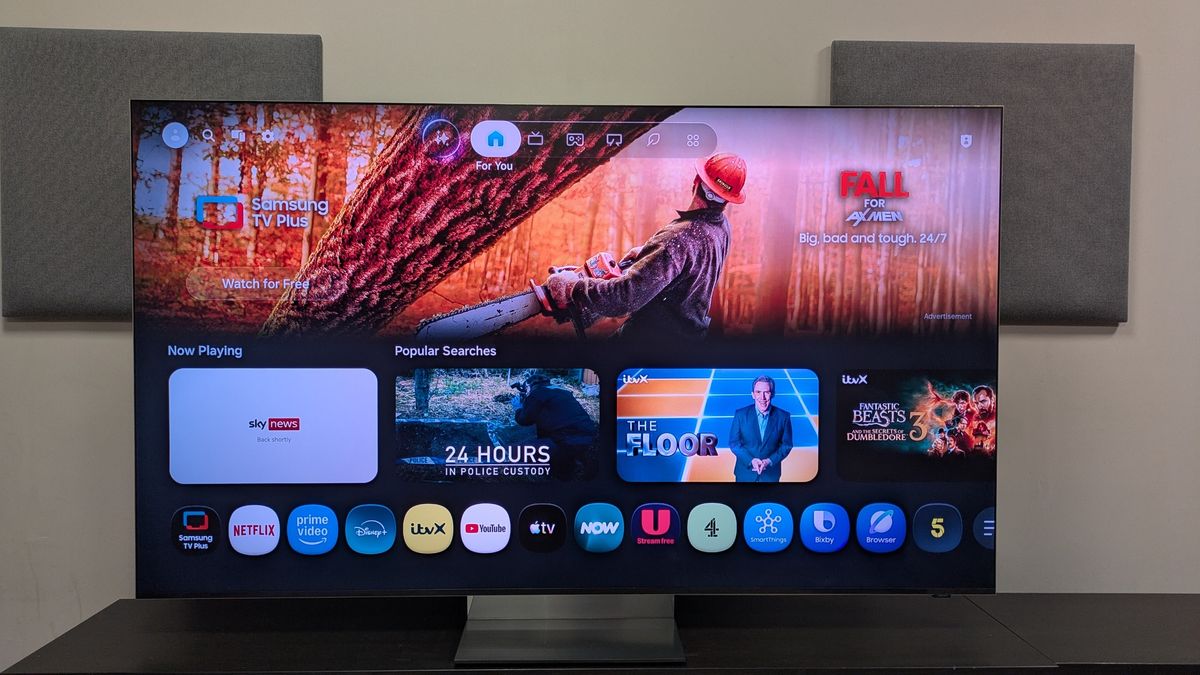
The R95H uses Samsung's own Tizen platform as its smart TV (Image credit: Future)
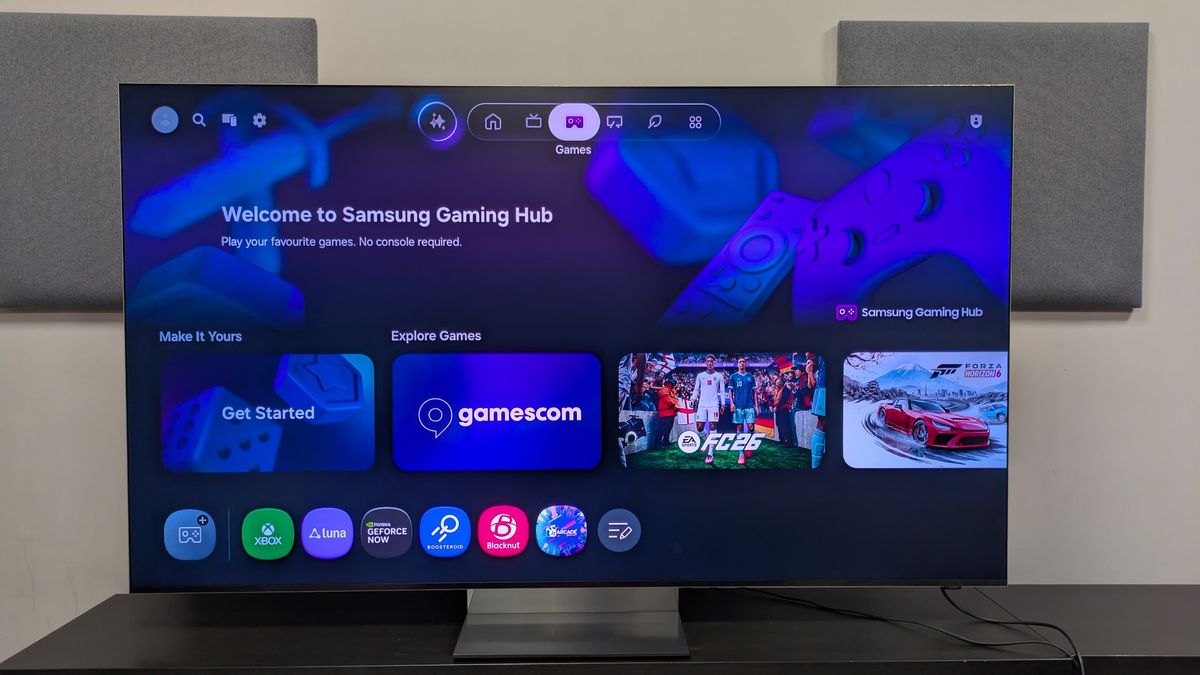
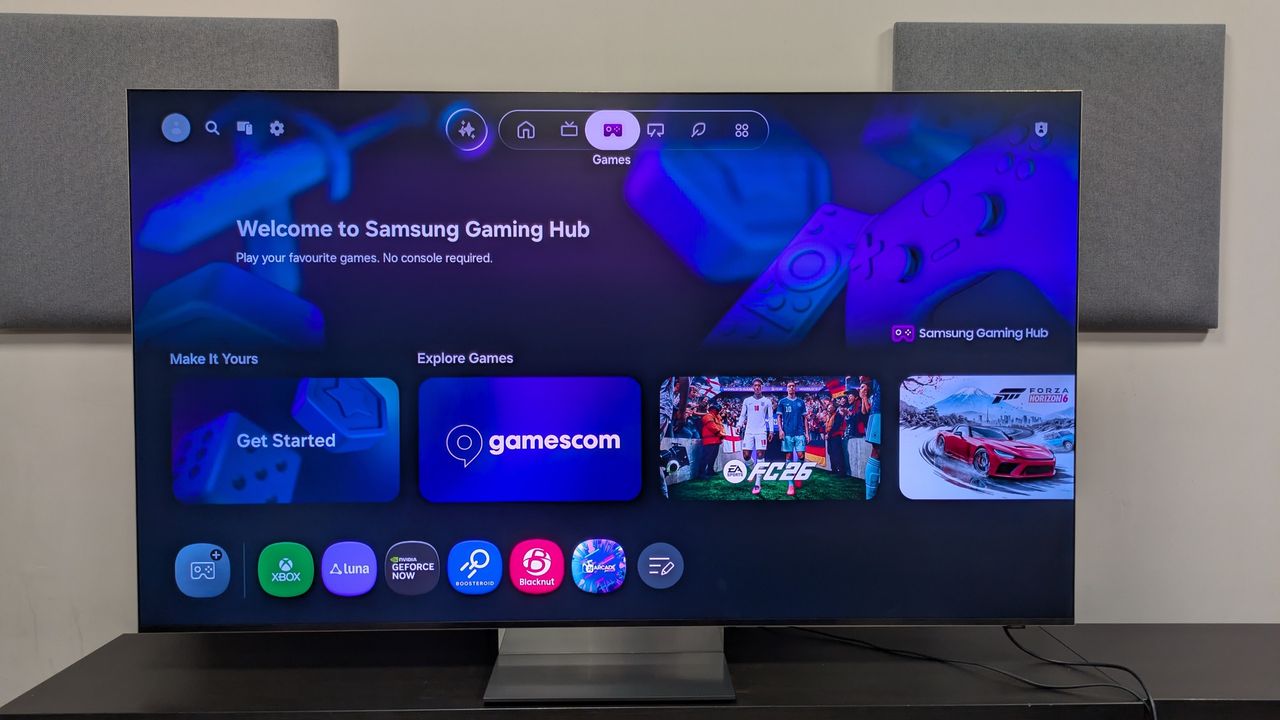
The Game Hub houses cloud gaming apps (Image credit: Future)
Image 1 of 2
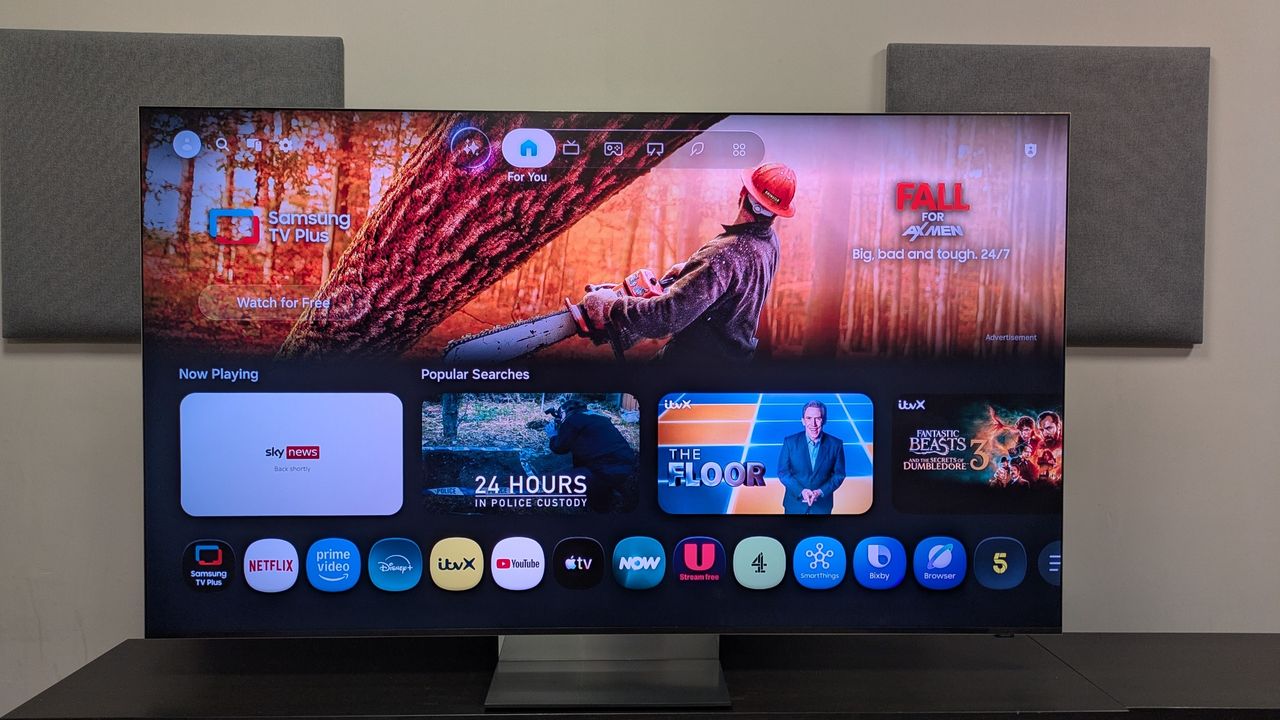
Image 2 of 2
One UI Tizen smart TV platform
Hubs including Home and Game
Good range of settings
As with all Samsung TVs, the R95H uses Samsung’s own Tizen OS smart TV platform, now known as One UI Tizen. Tizen has several different hubs, including the Home hub, where apps and TV shows and movie recommendations are presented, and Game hub, where cloud gaming apps are housed. There are also Daily and Art hubs, for lifestyle and art-themed apps respectively.
Tizen supports a wide array of apps, including major streaming services such as Netflix, Prime Video and Disney. In the UK, streaming services such as BBC iPlayer and ITVX are supported. It should be noted that Tizen doesn’t use Freely or Freeview for live TV, instead using its own Samsung TV Plus system.
Various AI features are supported, including the Samsung Vision AI Companion, which can be used to find specific content, or answer more general questions that you ask the AI. Also included are other AI picture and sound features, as discussed in the Features section above.
Tizen is good at offering recommendations, and the Home hub is well laid out, but as with all smart TV platforms nowadays, there's a large banner ad at the top of the screen that can be intrusive when you're trying to navigate.
Menus are well laid out and easy to navigate, and there are a good number of settings, enabling you to tailor the picture to your preferences. Tizen is fairly straightforward to use, although I did find that Samsung TV Plus would play if I lingered on the Home menu, which could be frustrating.
Smart TV & menus score: 4.5 / 5
Samsung R95H review: Gaming
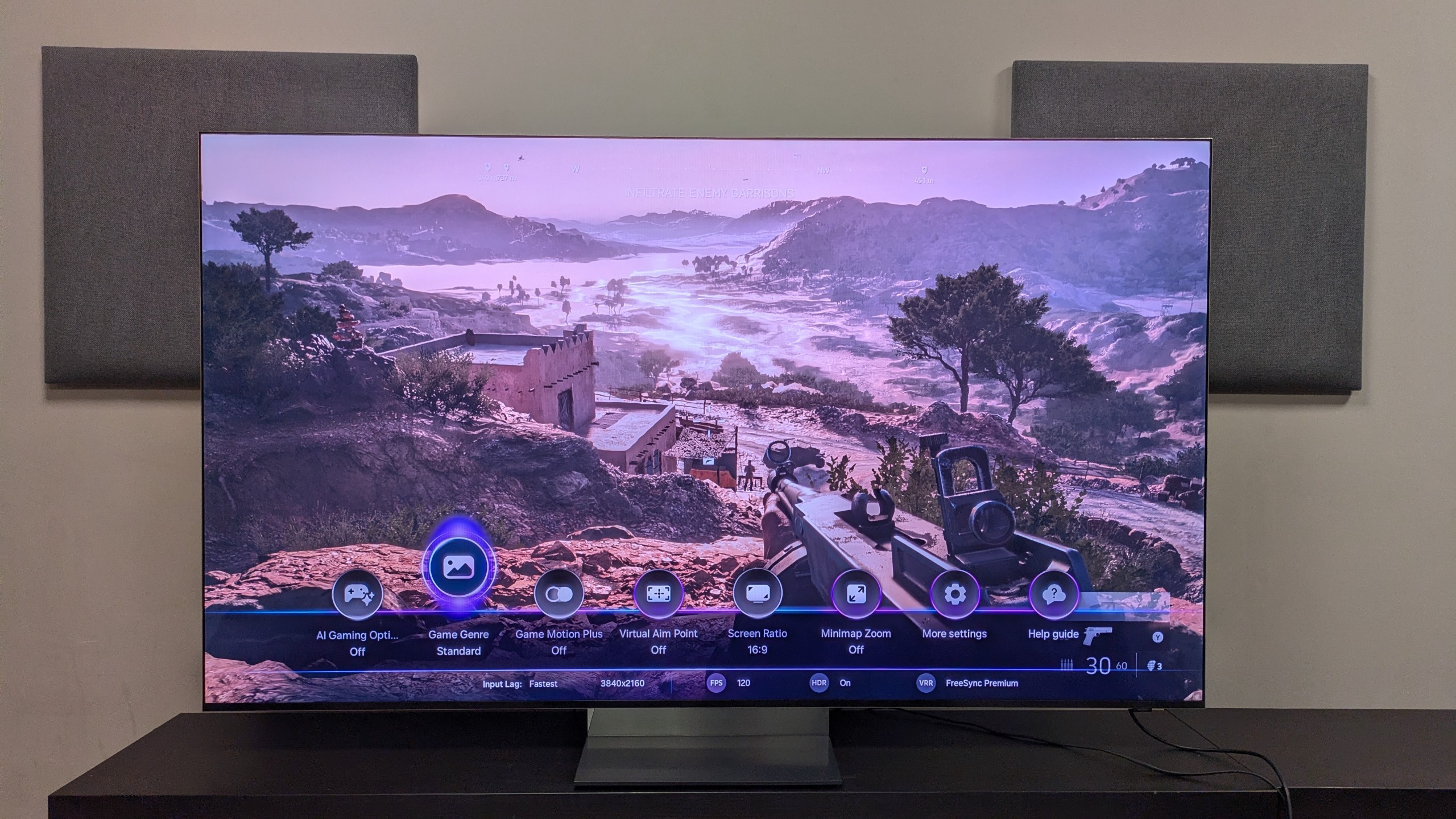
The R95H has a stacked feature list for gaming with great performance to match (Image credit: Future)
Four HDMI 2.1 ports
11.7ms input lag time
4K 165Hz, FreeSync and G-Sync supported
The R95H has four HDMI 2.1 ports, all of which are fully equipped for gaming. It supports 4K 165Hz, full VRR including Freesync and G-sync, HDR10+ gaming and ALLM. There's a dedicated Game menu where you can adjust game-specific settings, and the Game Hub, which houses cloud gaming apps such as Xbox, Nvidia GeForce Now, and Luna.
When I measured the R95H’s input lag, it registered an 11.7ms (4K 60Hz) time. This is below the 15ms input lag time we look for, but is higher than other Samsung TVs I’ve tested, which all tend to register sub-10ms times.
Actual gameplay on the R95H is smooth, even during fast-paced action. Playing Battlefield V on Xbox Series X, the R95H easily handled the chaotic gunfights as I had to snap from target to target, showing no signs of judder or stutter. The Game picture mode rendered crisp textures and accurate colors for the most part, though I did find it favored red tones in one desert mission I played. Overall, though, the R95H is a superb gaming TV.
Gaming score: 5 / 5
Samsung R95H review: Value
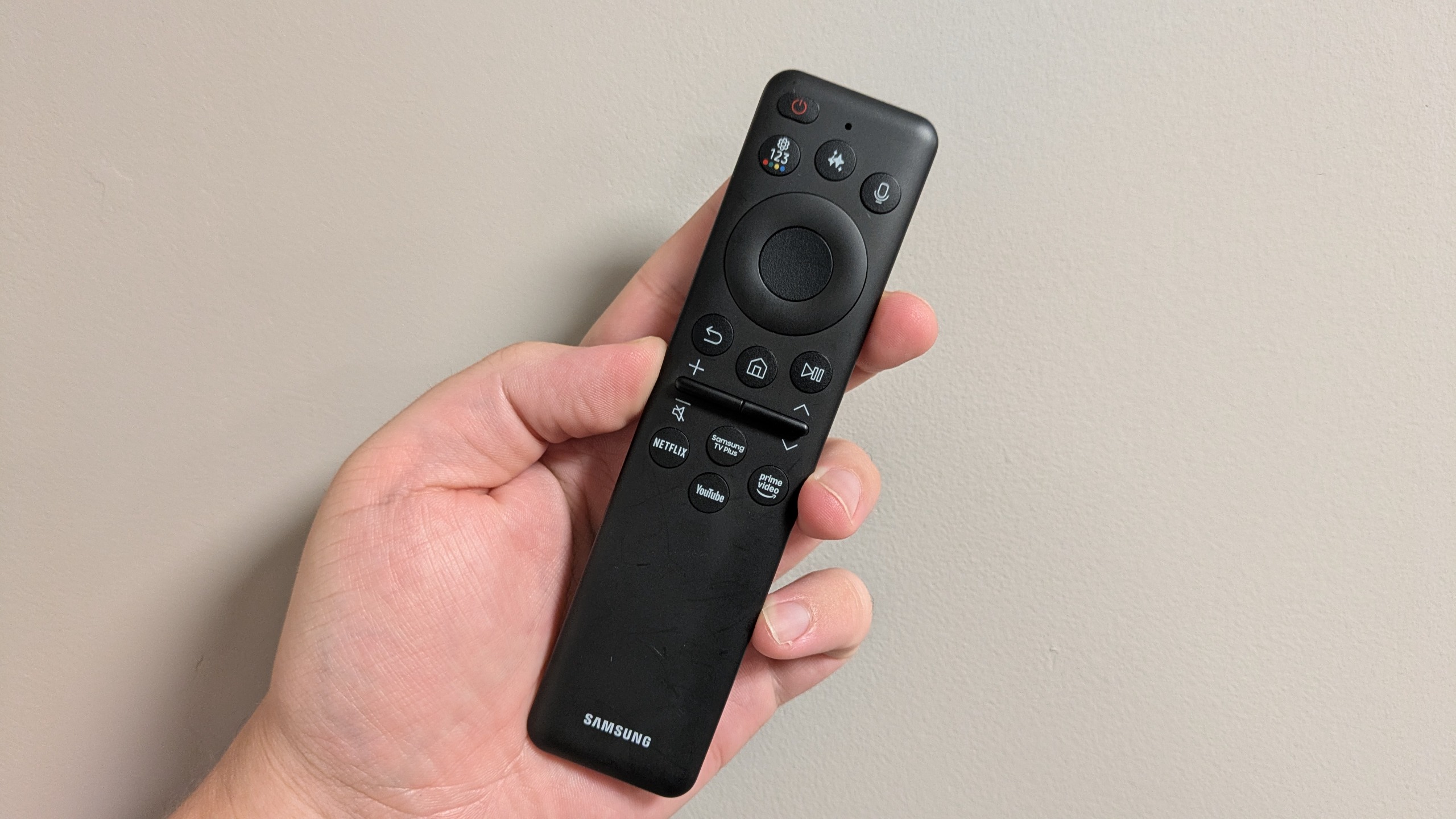
Samsung's SolarCell remote is still one of the best available (Image credit: Future)
Premium priced TV
Similar price to OLEDs
Good performance and features
The R95H is a premium TV, with the 65-inch model I tested available for around $2,799 / £2,899 / AU$4,795 at the time of writing. This puts it in a similar price bracket to flagship OLEDs, such as Samsung’s S95H/S99H, which costs $2,799 / £2,899 / AU$5,295, and the LG G6, which costs $2,699 / £2,999 / AU$4,995 for a 65-inch. Compared to other RGB TVs I’ve tested, it’s one of the pricier models, but is cheaper than the rival flagship Sony Bravia 9 II, the 65-inch model of which costs $3,599 / £3,499 / AU$5,995.
The R95H commands a premium price, but does deliver premium performance and features similar to those rival OLEDs and RGB TV mentioned above. Since its release, prices for the R95H have dropped, and I anticipate they’ll continue to drop from now on, improving its value proposition. For now, I don’t think it can quite outshine rival OLEDs for the money, but it's close, and this is still a very good TV.
Value score: 4 / 5
Should I buy the Samsung R95H?
(Image credit: Future)
Buy it if...
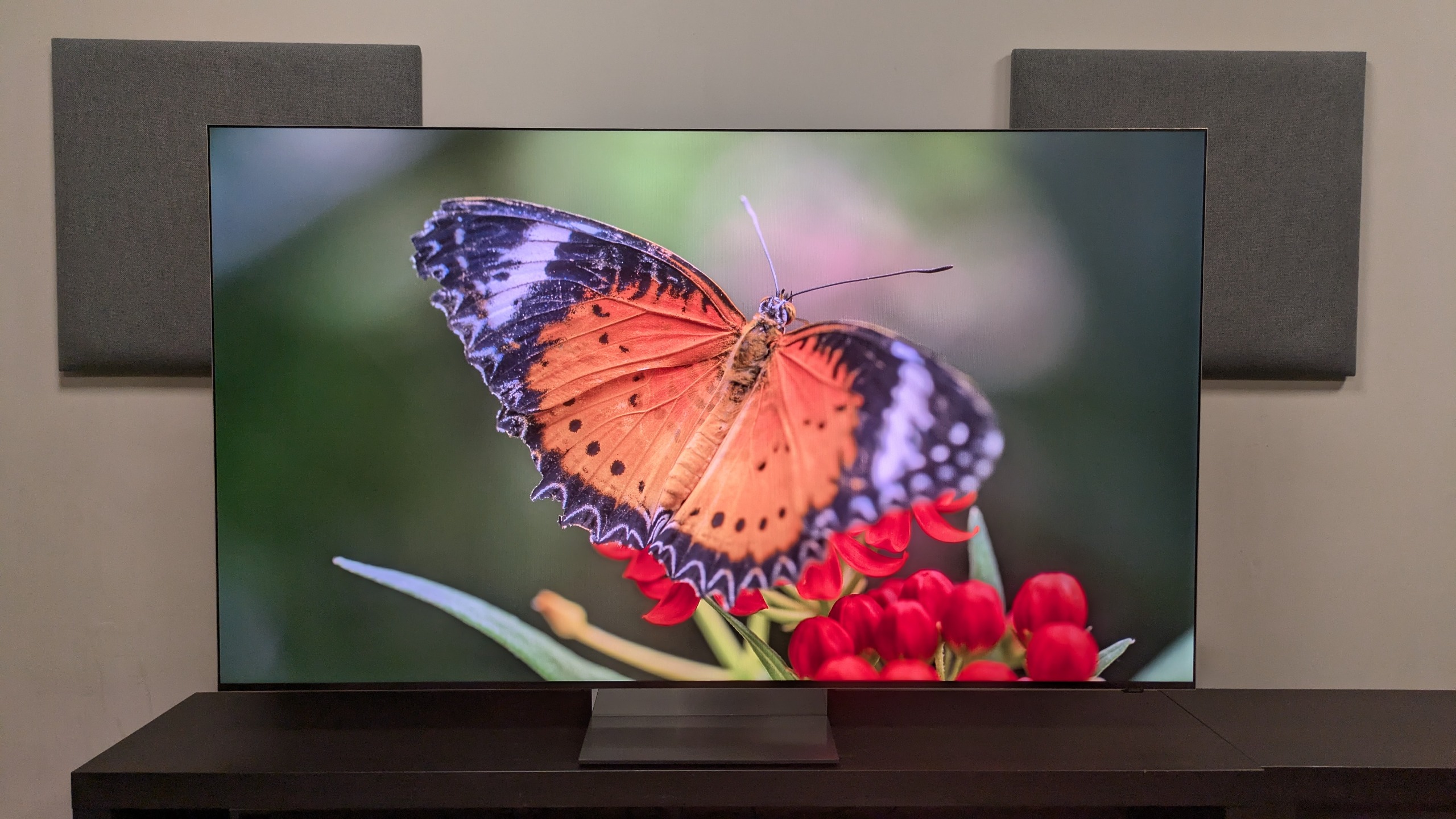
You want brilliant picture quality The R95H's picture is vibrant, colorful and detailed. Add in strong contrast, rich black tones and a glare-free screen, and the R95H's really impresses.
You want a TV for gaming The R95H is packed with all the gaming features you could need, and delivers terrific performance to match.
You want to watch in a bright room The R95H's glare-free matte screen makes watching in bright rooms easy, doing a great job at eliminating reflections.
Don't buy it if...
You're on a budget The R95H is a flagship TV and carries a premium price. While it has excellent features and performance, cheaper RGB TVs and OLEDs with similar features are available.
You want Dolby Vision HDR The R95H, like all Samsung TVs, doesn't support Dolby Vision HDR.
You want the very best picture quality While the R95H boasts very good picture quality, it still doesn't quite beat the best OLEDs for me.
Also Consider
(Image credit: Future)
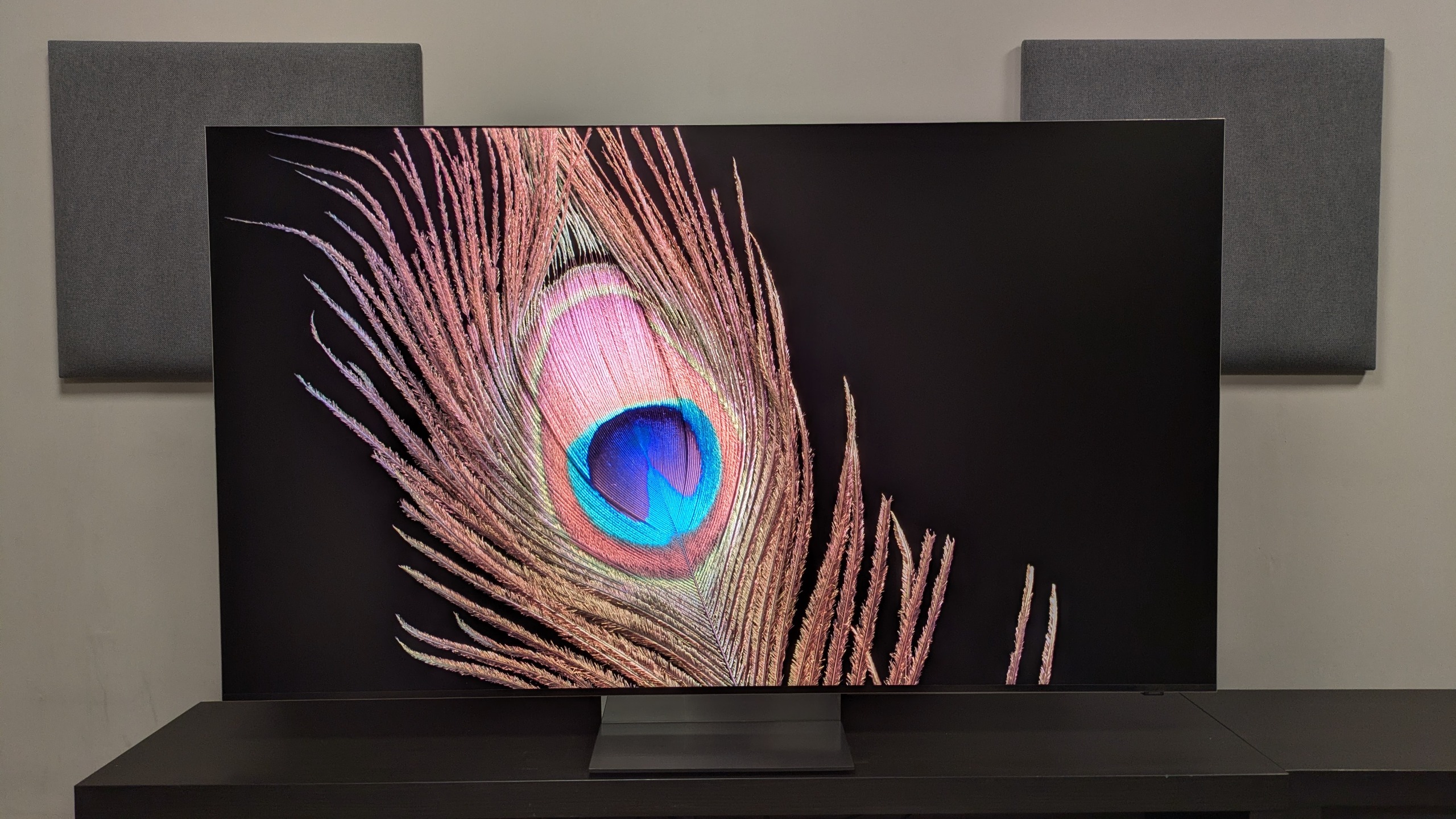
Samsung S95H (US and AU) / S99H (UK) The Samsung S95H/S99H is Samsung's flagship OLED and offers the same gaming features as the R95H, as well as the same smart TV interface, for near-enough the same price. Where the S95H/S99H has the advantage is in its richer-contrast picture quality and detail. If you want OLED, this is the TV to choose.
Read our full
LG G6 LG's flagship OLED for 2026, the LG G6 supports Dolby Vision HDR support and offers OLED quality picture compared to the R95H. In terms of price, they're near-identical, and both do a offer a full list of smart and gaming features. Your choice will come down to LG vs Samsung preference.
Read our full
Sony Bravia 7 II Sony's 'more affordable' RGB TV delivers excellent picture quality, with colors that actually rival, and sometimes beat, the R95H. Plus, it's a lot cheaper. It does lack the same level of features and gaming performance, and isn't as strong performing in bright rooms. This choice will come down to budget.
Read our full
How I tested the Samsung R95H
(Image credit: Future)
Tested over a few weeks
Tested in varying light conditions in our testing lab
Measurements taken using Portrait Displays Calman software
The first step of my testing was casual viewing to establish the best pictures modes. For sports and daytime TV, Standard worked best, and for movies and TV shows, I switched between Movie and Filmmaker depending on the content.
After this, I did my critical viewing using reference 4K Blu-ray scenes to test color, contrast, motion and detail. I also used SDR broadcast TV to test upscaling, as well as sports to test the R95H's sports viewing.
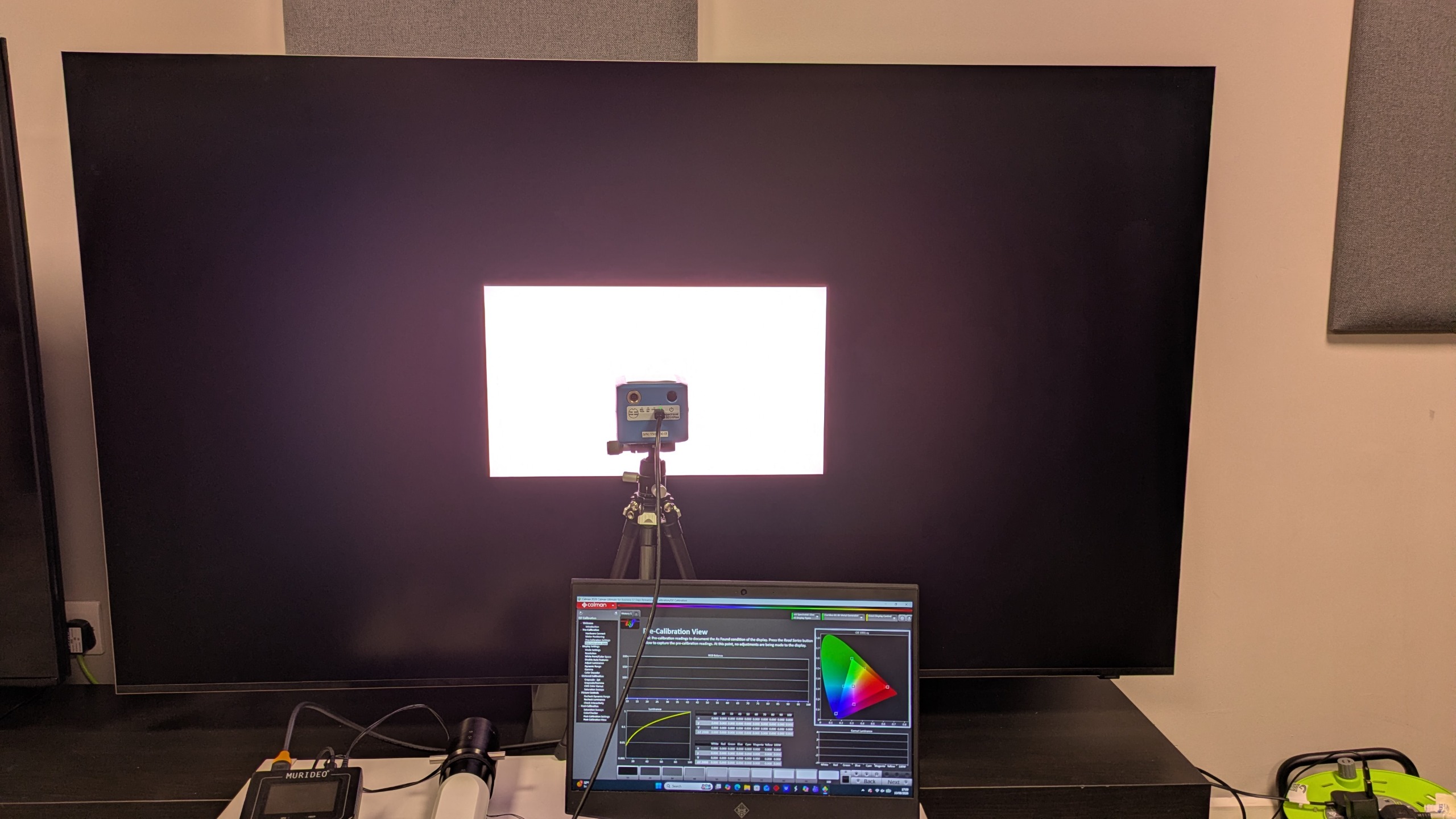
Next, I tested the R95H using specialized measuring equipment, including a Murideo Six G 8K metal test pattern generator, Klein K-10A colorimeter and Jeti Spectral 15VA spectroradiometer and Portrait Displays' Calman color calibration software.
To test brightness, I took SDR and HDR brightness measurements using white window patterns in sizes 1-100%, focusing on peak (10%) and fullscreen (100%) measurements.
After this, I tested color and grayscale accuracy in SDR, using Delta-E values (the margin for error between the test pattern signal source and what is displayed on screen.)
Next, I tested HDR color gamut coverage, using the BT.2020 and UHDA-P3 color spaces. The closer to 100%, the better.
Finally, I measured the R95H's input lag using a Leo Bodnar 4K HDMI Input Lag Tester.
We also do two new tests as part of our testing. The first is the HDR EOTF, which shows the accuracy of a TV's brightness across its range, using 1,000, 4,000 and 10,000 nits targets. Then, there is the Spectral Power Distribution test, which measures how a TV recreates colors.
First reviewed: September 2026